CIVIL & ENVIRONMENTAL ENGINEERING · STANFORD
Hi, I’m Yuyan.
My research focuses on sensing through interaction traces.
I joined Stanford University as a Ph.D. student in Fall 2022 and expect to graduate in 2027. I am advised by Prof. Hae Young Noh in the Structures as Sensors Lab.
My research focuses on sensing through the physical environment: inferring human and animal activity, health states, and physical properties from mechanical responses induced in surrounding structures and fluids by subject–environment interactions.
From 2018 to 2022, I studied at the School of the Gifted Young at the University of Science and Technology of China (USTC) and graduated with dual degrees in Applied Physics and Computer Science.
RESEARCH FRAMEWORK
Sensing through interaction traces.
Every interaction between a subject and its environment leaves a trace. I develop sensing methods to reveal, enhance, and interpret these traces.
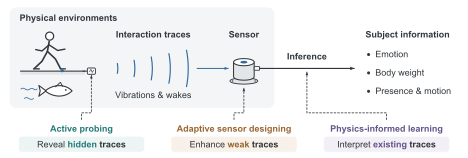
Reveal hidden traces
Enhance weak traces
Interpret existing traces
Research projects
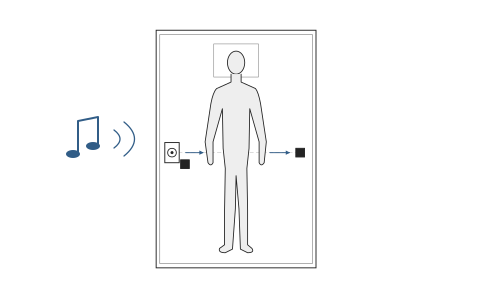
01 Reveal hidden traces
Body weight estimation
Music-induced bed vibrations reveal body weight.
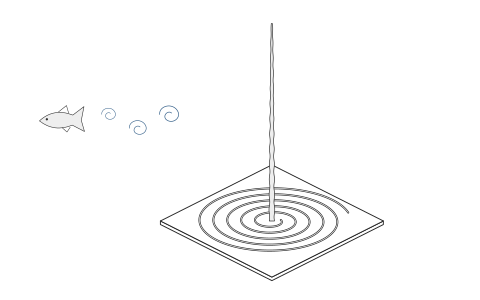
02 Enhance weak traces
Fish monitoring
Whisker design makes fish wakes stand out from background flow.
03 Interpret existing traces
Emotion recognition
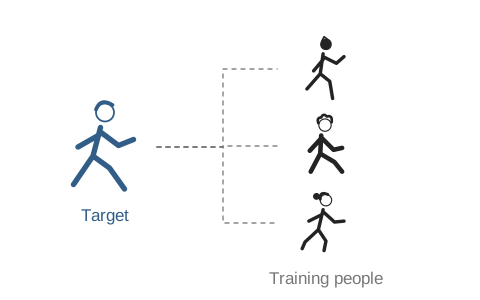
Footstep-induced floor vibrations reveal emotion, with learning personalized by gait similarity.
Try it here.
Collapse −Expand +
Research approaches
A person rests on a bed.
Body weight changes the mechanics of the coupled body–bed system.
Music excites the bed.
Music-induced vibrations carry traces of how the person’s body changes the bed’s response.
Vibration sensors record the response.
Vibration sensors on the bed frame measure how the vibrations propagate through the bed–body system.
The model estimates body weight.
The model links these interaction traces to body weight using structural dynamics and physics-informed learning.
REVEAL HIDDEN TRACES
Music excites the bed, making the body’s effect on vibration transmission measurable. Our system interprets this interaction trace through a transfer function and a neural network guided by bed–body structural dynamics.