02 Enhance weak traces
Fish monitoring
We design whisker-inspired sensors to detect fish wakes amid background flow.
The wavy whisker shape suppresses self-induced vibration in background flow, helping a passing wake stand out. The spiral-perforated base amplifies the vibration response in the target wake-frequency band.
Whisker-inspired sensing · IMAC 2026 ↗Making fish wakes stand out from background flow
CONCEPTUAL DEMOCompare a smooth whisker with our wavy whisker and spiral base. Send a fish past to see how each responds amid background flow.
Wavy shapeSuppresses flow-induced self-vibration
Spiral baseAmplifies the target wake response
More signal, less flow-induced noise
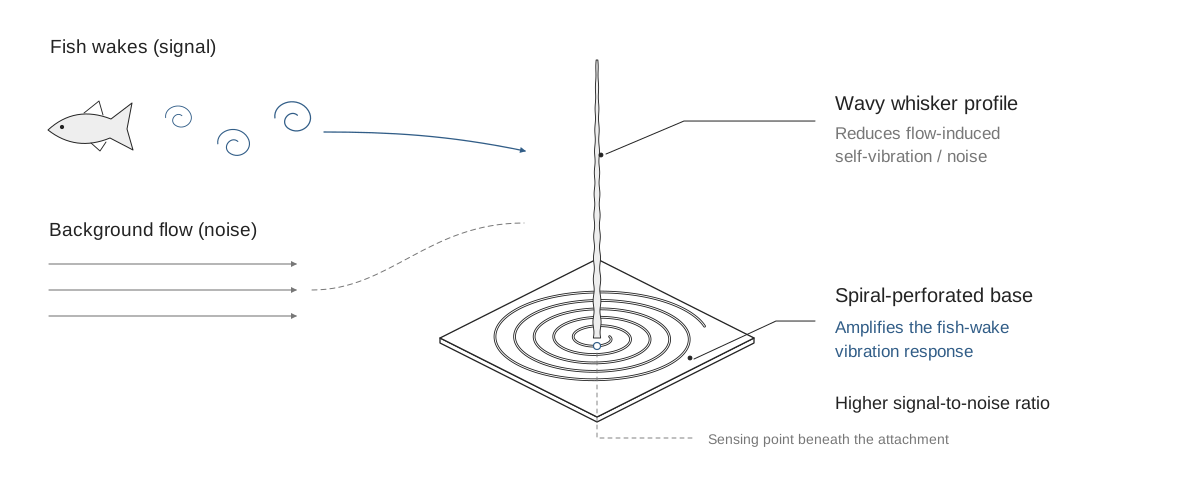
Two mechanisms improve signal-to-noise ratio. The wavy whisker reduces background-flow-induced self-vibration. The spiral-perforated base amplifies the fish-wake response in the target frequency band. Paper ↗
Reference
PAPER
- [1]
Y. Wu, S. Giridharan, L. Ma & H. Y. Noh (2026). Seal Whisker-Inspired Sensor for Amplifying Wake-Induced Vibrations in Underwater Marine Animal Monitoring. IMAC-XLIV.Open author preprint (2025): design analysis and frequency-response evaluation.